Boeing 787-9 vs Airbus A350-900: The Real Difference
By CheapoTrav Editorial · 7 min read · Long-haul aircraft compared on range, cabin, and comfort.
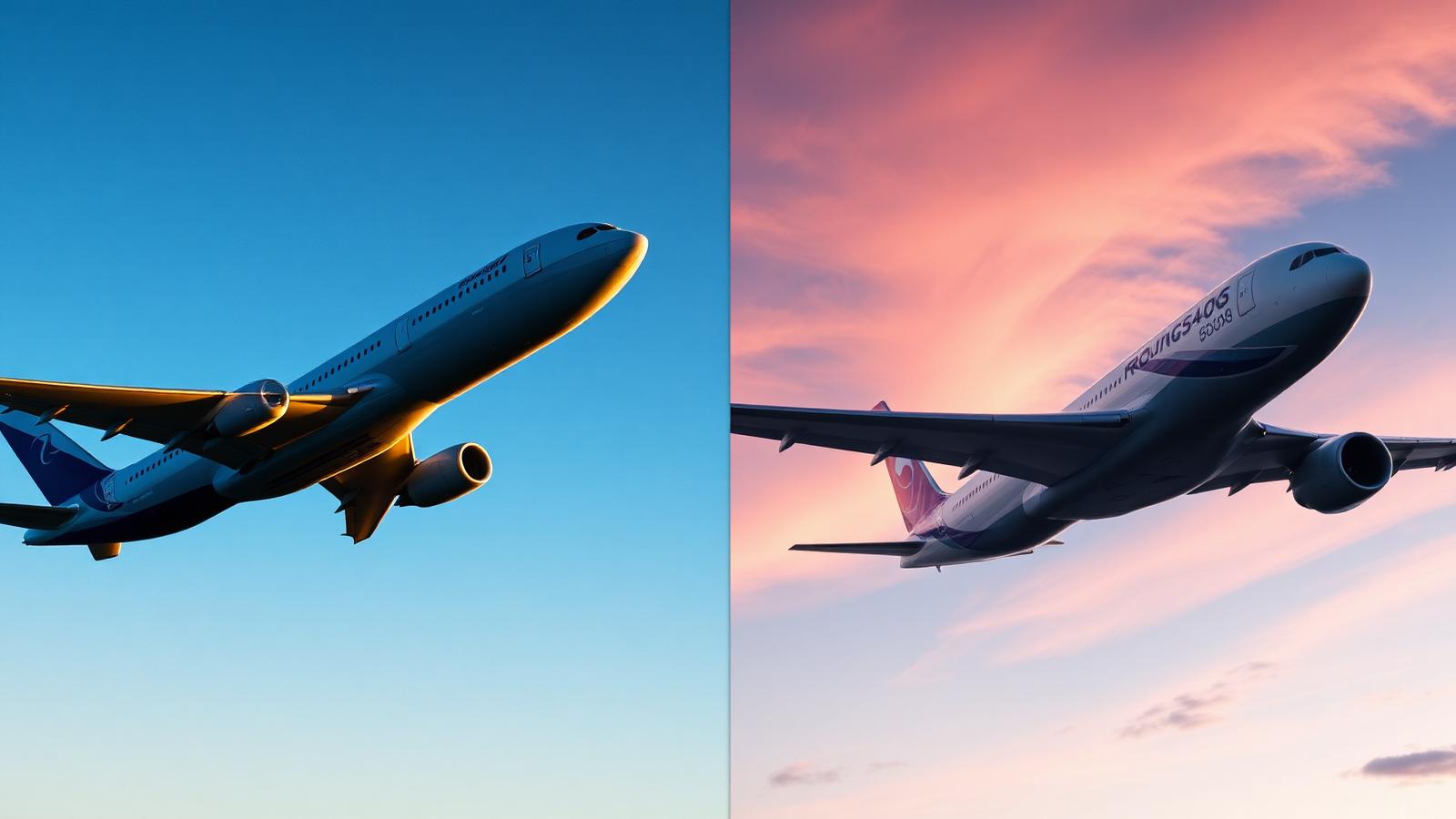
- Both are twin-engine widebodies designed for the same long-haul market — they overlap far more than they differ.
- The A350-900 has a slightly longer range (~15,000 km) and a wider cabin than the 787-9 (~14,140 km).
- The 787-9 has the lowest cabin altitude in commercial service (6,000 ft) and larger electronically dimmable windows.
- Airline cabin configuration matters more than the airframe for most passengers.
- For seat-by-seat comparisons on a specific route, call CheapoTrav at 1 (815) 991-4848.
Aircraft geek forums have argued this for a decade: 787 vs A350. Both entered service in 2013. Both are twin-engine, carbon-composite widebodies aimed at long-haul point-to-point routes that the 747 and A340 used to fly. Both have opened up new city pairs that older aircraft couldn't fly economically. And in the airlines that operate both, they often fly the same routes on alternate days.
So which is better? The honest answer is it depends what you're comparing — and in most cases, the airline's specific interior matters more than the model. Here's the full breakdown.
1. Range and route flexibility
The Airbus A350-900 wins on paper: about 15,000 km (8,100 nm) of range versus 14,140 km (7,635 nm) for the Boeing 787-9 Dreamliner. That extra ~900 km is why Singapore Airlines flies the world's longest scheduled flight (Singapore to Newark, 15,300 km) on an A350-900 variant, not a 787.
In practice, either aircraft can fly essentially any long-haul route in daily commercial service. The 787-9 handles Los Angeles–Sydney, London–Perth, and New York–Tokyo without a problem. The range gap only matters for a handful of ultra-long-haul routes at the fringe of what twinjets can do.
2. Passenger capacity and cabin width
The A350-900 seats 300–350 passengers in typical configurations. The 787-9 seats 248–296. The gap comes from the A350's wider fuselage — about 5 inches wider than the 787 at armrest height.
That difference matters in economy. Both aircraft support 3-3-3 economy layouts, but on the A350 that layout is genuinely comfortable, while the 787's 3-3-3 (used by nearly every airline now) leaves economy seats around 17.2 inches wide — narrower than the 3-3-3 on a 777 or A350. If you fly economy on long-haul, this is the single biggest passenger-experience difference between the two.
A few airlines still fly 787s in a more comfortable 2-4-2 economy layout (Japan Airlines is the main example), but they're the exception.
3. Cabin altitude, humidity, and windows
Both aircraft use carbon-composite fuselages, which allows higher cabin pressurization and humidity than aluminum-fuselage jets like the 777. This meaningfully reduces jet lag on long flights.
The 787-9 wins on cabin altitude: it maintains a cabin pressure equivalent to 6,000 feet elevation, versus about 6,500 ft on the A350 and 8,000 ft on older widebodies. Lower is better — less dehydration, less headache, less fatigue.
The 787-9 also wins on windows: the Dreamliner has the largest passenger windows in commercial service, and they dim electronically instead of using pull-down shades. On day flights across ocean sunsets, the difference is dramatic.
4. Speed and quietness
Both cruise at Mach 0.85 (~488 knots), so trip times are effectively identical on the same route. Both are noticeably quieter than older widebodies. The A350's Trent XWB engines are slightly quieter at the back of the cabin than the 787's engines; the 787's cabin dampens engine noise slightly better in the forward sections. In practice, both are the two quietest long-haul aircraft in commercial service.
5. Engines and reliability
The 787-9 uses either GE GEnx-1B or Rolls-Royce Trent 1000 engines (airline's choice). Early Trent 1000 durability issues caused significant groundings between 2016 and 2019 — those have been resolved, but they're part of the aircraft's history.
The A350-900 uses only the Rolls-Royce Trent XWB-84, which has been remarkably reliable since entry into service. Both aircraft now have excellent dispatch reliability records.
6. Side-by-side spec sheet
| Specification | Boeing 787-9 | Airbus A350-900 |
|---|---|---|
| First flight | 2013 | 2013 |
| Range | 14,140 km (7,635 nm) | 15,000 km (8,100 nm) |
| Typical seats | 248–296 | 300–350 |
| Length | 62.8 m | 66.8 m |
| Wingspan | 60.1 m | 64.8 m |
| Cruise speed | Mach 0.85 (488 kts) | Mach 0.85 (488 kts) |
| Cabin altitude | 6,000 ft | ~6,500 ft |
| Engines | 2 × GEnx-1B or Trent 1000 | 2 × Trent XWB-84 |
| Notable feature | Composite fuselage, dimmable windows | Longest-flight capable, wider cabin |
7. Which airlines operate each?
The 787-9 fleet is broader globally: United, American, British Airways, Air France, Lufthansa, Qantas, ANA, JAL, Virgin Atlantic, Air Canada, Air New Zealand, Turkish, KLM, Aeromexico, Air India, LOT, Korean Air, Saudia, EgyptAir, Ethiopian, Vietnam Airlines, and China's big three all fly it.
The A350-900 has grown fast: Delta, Singapore Airlines, Cathay Pacific, Qatar Airways, Lufthansa, Air France, China Airlines, Turkish, Vietnam Airlines, Iberia, Thai Airways, Malaysia Airlines, Finnair, Ethiopian, Air China, China Eastern, Air India, Korean Air, EVA Air, Swiss, and Fiji Airways all operate the -900.
Several airlines — Lufthansa, Air France, ANA (via 787), Turkish, Vietnam, Ethiopian — fly both types. On those routes, checking the specific equipment before you book is worthwhile.
8. Which one should you pick?
For most passengers on most routes, both aircraft are excellent choices — dramatically better than older widebodies. That said:
- Pick the A350-900 if you're in economy on a very long flight (12+ hours) and the airline uses a 3-3-3 layout. The extra fuselage width shows up in seat comfort.
- Pick the 787-9 if jet lag hits you hard — the lower cabin altitude genuinely helps. And if you like watching the world outside, the big electronic windows are a real perk.
- Either works well if you're in business class — both offer lie-flat layouts, and the specific airline's business product (Qatar Qsuite, ANA The Room, Singapore Business, etc.) matters far more than the airframe.
Above all: the specific configuration your airline uses on the specific route determines your actual experience. A 787 with 2-4-2 economy will beat an A350 with a cramped 3-3-3. Check the cabin map on the 787-9 aircraft page or the A350-900 aircraft page before you book.
9. Finding fares on the aircraft you want
Booking sites don't usually let you filter by equipment type. If you want the A350 over the 787 (or vice versa), you're often stuck reading through flight-detail pages one at a time.
CheapoTrav's phone line at 1 (815) 991-4848 is a shortcut. Agents can filter by aircraft type on multi-airline searches and surface unpublished fares that consolidator inventory makes available on both airframes. If you're an aircraft geek — or just someone who won't fly on a cramped 3-3-3 economy — that's usually the fastest way to find the flight you actually want.
Frequently asked questions
Is the Boeing 787-9 or Airbus A350-900 better?
Neither is objectively better — they target the same long-haul market with different trade-offs. The A350-900 has slightly longer range (about 15,000 km vs 14,140 km), a wider fuselage that supports a more spacious 3-3-3 economy cabin, and slightly newer-generation systems. The 787-9 has a lower cabin altitude (6,000 ft), larger electronically dimmable windows, and is deployed by more airlines globally. For most passengers, the airline's specific seat configuration matters more than the airframe.
Which has more range, the 787-9 or the A350-900?
The Airbus A350-900 has a longer range at approximately 15,000 km (8,100 nautical miles) versus 14,140 km (7,635 nautical miles) for the Boeing 787-9. Singapore Airlines operates the world's longest scheduled flight (Singapore to Newark) with an A350-900ULR variant, which is a further-range version of the same airframe.
Which is more comfortable, the 787-9 or the A350-900?
Both are noticeably more comfortable than older widebodies. The A350-900 has a slightly wider cabin (about 5 inches wider than the 787), which gives it more room in a 3-3-3 economy layout. The 787-9 has a lower cabin altitude pressurization equivalent to 6,000 feet (versus 8,000 feet on older aircraft) and larger windows that dim electronically instead of using pull-down shades. Both use higher cabin humidity than older jets, which reduces jet lag.
How many passengers does each aircraft carry?
The Boeing 787-9 typically seats 248–296 passengers in a two- or three-class configuration. The Airbus A350-900 typically seats 300–350 passengers in a comparable configuration. The A350-900's wider fuselage lets airlines fit more seats without cramming them tighter.
Which airlines fly the 787-9 vs the A350-900?
Both are flown widely across the world's major airlines. The 787-9 is operated by United, American, British Airways, Air France, Lufthansa, Qantas, ANA, JAL, Virgin Atlantic, Air New Zealand, Air Canada, and many others. The A350-900 is operated by Delta, Singapore Airlines, Cathay Pacific, Qatar Airways, Lufthansa, Air France, China Airlines, Turkish Airlines, Vietnam Airlines, and others. Several airlines fly both.
Should I choose a flight based on the aircraft type?
For long-haul flights (7+ hours), it can be worth checking. Both the 787-9 and A350-900 are considerably more comfortable than older widebodies like the 777-200 or A340 — lower cabin altitude, better humidity, quieter cabin. Between the two, the specific airline's cabin configuration (economy pitch, seat width, whether it has premium economy) usually matters more than the airframe itself. CheapoTrav's aircraft pages show which airlines fly each type.
How do I find flights on a specific aircraft type?
Most booking sites show the equipment type on the flight details page, though it's not always searchable directly. Call the CheapoTrav phone line at 1 (815) 991-4848 and ask for options on a specific airframe — agents can filter by equipment when searching multi-airline routes, which is useful for anyone who prefers one aircraft over another on long-haul flights.